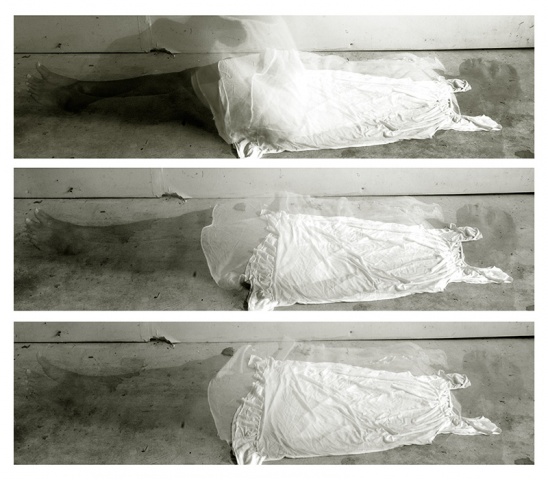
Transforming Memory / Liberating Identity
“I’m interested in the tangled web of history, in the rough edges, and the bumpy surface, the mess just beneath the veneer of order.”
From an interview with Carrie Mae Weems discussing her work, The Hampton Project.

It is easy to recognize Jennifer Fairfax’s use of memory as a conduit in her photographs: the braided hair forms a connection, a “lifeline” between the photographs of her grandparents, the laconic journal entry of her grandmother, and the well-worn tweed cap of her grandfather. Fairfax is keenly aware of the power of the camera as both a tool for cultural recovery and as a means towards forming connections between the past and present. She understands how inextricably intertwined personal memory and photography have become, and as she performs duo roles as both subject and artist, she devises images in which she often reconstructs herself as her grandmother, grandfather, or mother. However, Fairfax’s images are much more than recollections. They provide us with images to ponder and question not one black identity, but plural identities: class, gender, and sexuality as well as a set of representations and a range of experiences and varied conditions of blackness.


Peggy Feerick
Associate Professor, Photography
George Mason University